


Burgundy is one of the most storied and intricate wine regions in the world, revered for its ability to showcase the subtle differences between vineyard sites through the expressive lens of Pinot Noir and Chardonnay. More than anywhere else, Burgundy teaches us the language of terroir — the idea that wine can reflect the character of its specific place.
In Burgundy (and across France), wine regions are governed by the Appellation d’Origine Contrôlée (AOC) system, which outlines strict rules around geography, grape varieties, and winemaking practices to preserve regional identity. While American wine lovers may be more familiar with the term AVA (American Viticultural Area), AOC serves a similar purpose — both identify a wine’s origin and help convey its unique sense of place.
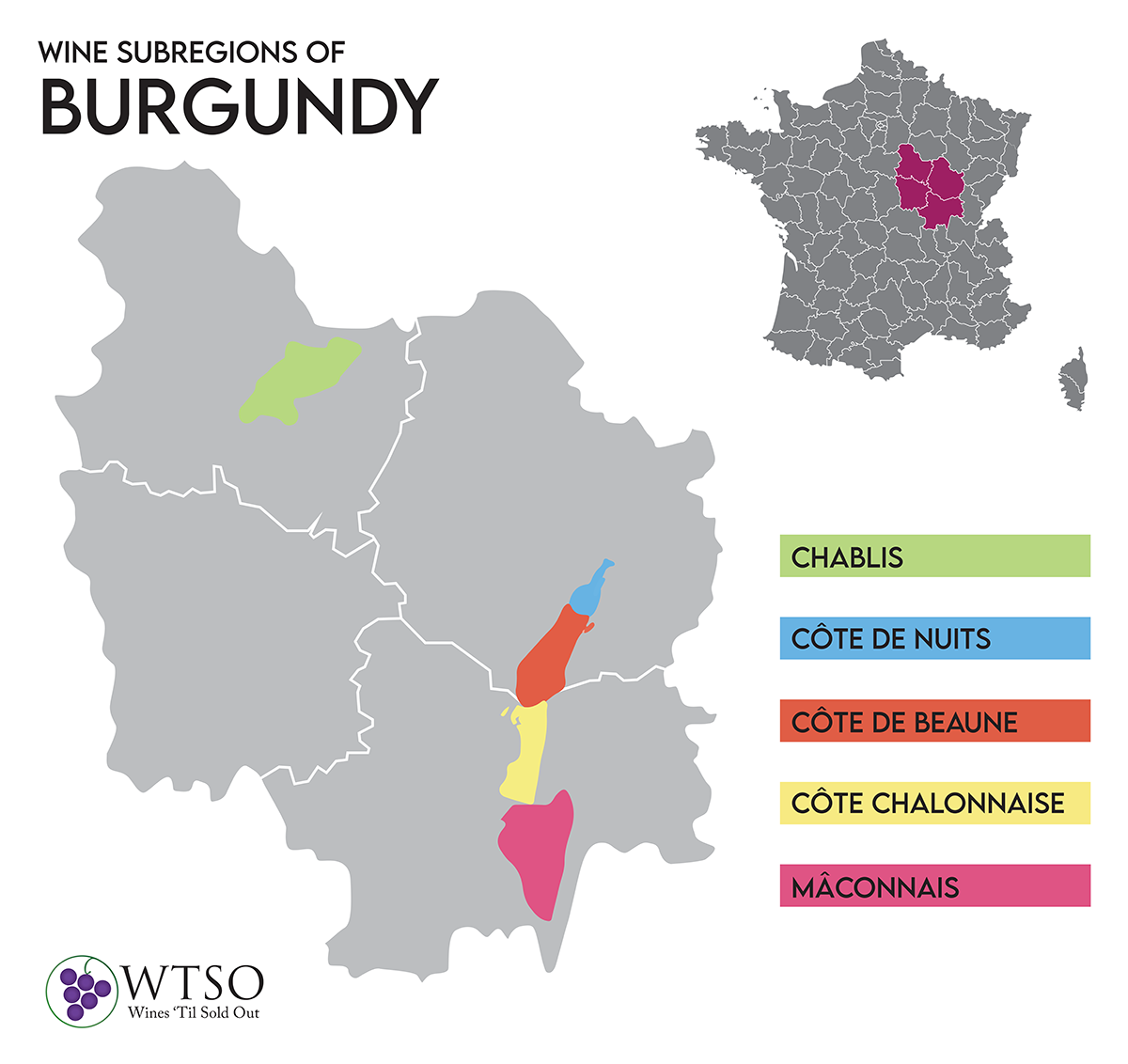
To truly appreciate Burgundy’s diversity, it helps to understand its five major subregions. Each offers a distinct mix of soil, slope, climate, and winemaking tradition — resulting in a rich tapestry of styles that delight wine lovers at every level.
Whether you’re expanding your Burgundy collection or diving into the nuances of village and Premier Cru designations, this guide will help you navigate the map (and the glass) with confidence.
1. Chablis – Purity & Precision in Northern Burgundy
Located in the northernmost part of Burgundy, Chablis is famous for producing some of the purest, most mineral-driven Chardonnay in the world. The region’s cool climate and Kimmeridgian limestone soils lend a signature saline quality and bright acidity that make these wines distinct.
- Grape: Chardonnay
- Style: Crisp, linear, citrusy, mineral
- Aging Potential: Medium (up to 10 years for Premier/Grand Cru)
- Key Terms: Petit Chablis, Chablis, Chablis Premier Cru, Chablis Grand Cru
Chablis wines are rarely oaked, and when they are, the treatment is subtle. These white wines are ideal for fans of clean, refreshing styles and pair beautifully with seafood and creamy cheeses.
2. Côte de Nuits – The Spiritual Home of Pinot Noir
Part of the larger Côte d’Or, the Côte de Nuits lies just south of Dijon and produces some of the world’s most revered Pinot Noirs. Its patchwork of climats and complex limestone soils give rise to wines of elegance, depth, and ageability.
- Grape: Pinot Noir
- Style: Earthy, structured, red/black cherry, spice, forest floor
- Aging Potential: High (especially Premier & Grand Cru)
- Notable Villages & Appellations:
- Gevrey-Chambertin – Power and structure, with darker fruit and firm tannins
- Côte de Nuits-Villages – Excellent value and diversity from surrounding communes
- Fixin, Marsannay, Nuits-St-Georges – More approachable yet expressive styles
This subregion is ideal for collectors and enthusiasts seeking reds that balance aromatic complexity with serious aging potential. Grand Cru wines like Romanée-Conti and Chambertin command astronomical prices, but village-level and Premier Cru bottlings offer impressive quality and nuance at more accessible price points.
3. Côte de Beaune – Balance of Red and White Burgundy
South of the Côte de Nuits, the Côte de Beaune is unique for its dual strength in both Chardonnay and Pinot Noir. It’s home to some of the most celebrated white wines in the world, as well as elegant, aromatic reds that express finesse over power.
- Grapes: Chardonnay & Pinot Noir
- Style (Chardonnay): Rich, nutty, citrus, with balanced oak
- Style (Pinot Noir): Red fruit-driven, floral, refined
- Notable Villages & Appellations:
- Meursault – Luxurious Chardonnay with ripe fruit and hazelnut notes
- Volnay – Light, perfumed Pinot Noir with silky tannins
- Beaune – A diverse commune producing both red and white wines, including many Premier Crus
- Savigny-lès-Beaune – Often underrated, producing vibrant, earthy Pinot Noir and some rare Chardonnay
- Saint-Romain – Higher-altitude vineyards yielding fresh, mineral-driven styles
- Santenay – A southern village offering great value with a mix of red and white wines
Côte de Beaune offers a rich playground for Burgundy lovers. Its wines can range from restrained and mineral to lush and opulent, depending on site and vintage.
4. Côte Chalonnaise – Hidden Gems & Everyday Elegance
Further south lies the Côte Chalonnaise, a less-famous subregion that punches well above its weight. Here, you’ll find excellent value-driven Burgundy with approachable pricing and expressive character.
- Grapes: Chardonnay, Pinot Noir, and Aligoté
- Style: Ripe, accessible, with good structure and freshness
- Notable Villages:
- Mercurey – Known for bold, structured Pinot Noir
- Givry – A source of both balanced reds and elegant whites
- Rully – Delivers crisp Chardonnay and traditional-method sparkling wine
- Montagny – White-only appellation, ideal for lovers of floral, vibrant Chardonnay
- Bouzeron – The only Burgundy village focused on Aligoté
With warmer weather and rolling hills, this subregion often ripens more easily, leading to generous fruit and well-rounded wines. It’s a go-to for Burgundy drinkers who want everyday bottles without sacrificing regional character.
5. Mâconnais – Sun-Soaked Chardonnay with Charm
The southernmost subregion, the Mâconnais, is a sun-drenched landscape ideal for growing ripe, fruit-forward Chardonnay. The wines are rounder and more immediately approachable, often with lower prices than their northern counterparts.
- Grape: Chardonnay
- Style: Juicy, full-bodied, orchard fruit, floral
- Notable Villages:
- Pouilly-Fuissé – Recently awarded Premier Cru designations; expressive and layered
- Viré-Clessé – Known for honeyed, rich whites with aging potential
- Saint-Véran – Delivers excellent value with creamy, fruit-driven Chardonnay
- Mâcon-Villages – A catch-all for regional wines, often overdelivering at entry-level prices
For those who love California Chardonnay but want to explore French terroir, the Mâconnais offers a perfect bridge.
Final Thoughts: Burgundy’s AOCs in Every Glass
Understanding Burgundy means embracing its complexity – and its subregions are your roadmap. From Gevrey-Chambertin’s bold reds to Meursault’s iconic whites, each AOC offers a new layer of discovery.
Collectors and enthusiasts alike are seeking out Premier Cru Pinot Noir, venturing into under-the-radar villages like Saint-Romain and Santenay, and tasting beyond entry-level Bourgogne to uncover Burgundy’s full spectrum of expression. With every bottle, you’re tasting not just a grape, but a place.
In recent years, securing top-quality Burgundy in the U.S. has become increasingly challenging. Tight allocations, lower yields from difficult vintages, and rising global demand have all contributed to limited availability and rising prices. When these wines do arrive stateside, they often disappear quickly – especially from producers with a strong following or from vineyards that saw reduced harvests due to frost or hail in recent years.
Keep this guide bookmarked as you explore Burgundy bottles across vintages and producers – it’s your companion for discovering what makes each glass uniquely unforgettable.